
[![PyPI - Python Version](https://img.shields.io/pypi/pyversions/ablkit)](https://pypi.org/project/ablkit/) [![PyPI version](https://badgen.net/pypi/v/ablkit)](https://pypi.org/project/ablkit/) [![Documentation Status](https://readthedocs.org/projects/ablkit/badge/?version=latest)](https://ablkit.readthedocs.io/en/latest/?badge=latest) [![license](https://img.shields.io/github/license/mashape/apistatus.svg?maxAge=2592000)](https://github.com/AbductiveLearning/ABLkit/blob/main/LICENSE) [![flake8 Lint](https://github.com/AbductiveLearning/ABLkit/actions/workflows/lint.yaml/badge.svg)](https://github.com/AbductiveLearning/ABLkit/actions/workflows/lint.yaml) [![Code style: black](https://img.shields.io/badge/code%20style-black-000000.svg)](https://github.com/psf/black) [![ABLkit-CI](https://github.com/AbductiveLearning/ABLkit/actions/workflows/build-and-test.yaml/badge.svg)](https://github.com/AbductiveLearning/ABLkit/actions/workflows/build-and-test.yaml) [📘Documentation](https://ablkit.readthedocs.io/en/latest/index.html) | [📄Paper](https://journal.hep.com.cn/fcs/EN/10.1007/s11704-024-40085-7) | [📚Examples](https://github.com/AbductiveLearning/ABLkit/tree/main/examples) | [💬Reporting Issues](https://github.com/AbductiveLearning/ABLkit/issues/new)

# ABLkit: A Toolkit for Abductive Learning **ABLkit** is an efficient Python toolkit for [**Abductive Learning (ABL)**](https://www.lamda.nju.edu.cn/publication/chap_ABL.pdf). ABL is a novel paradigm that integrates machine learning and logical reasoning in a unified framework. It is suitable for tasks where both data and (logical) domain knowledge are available.
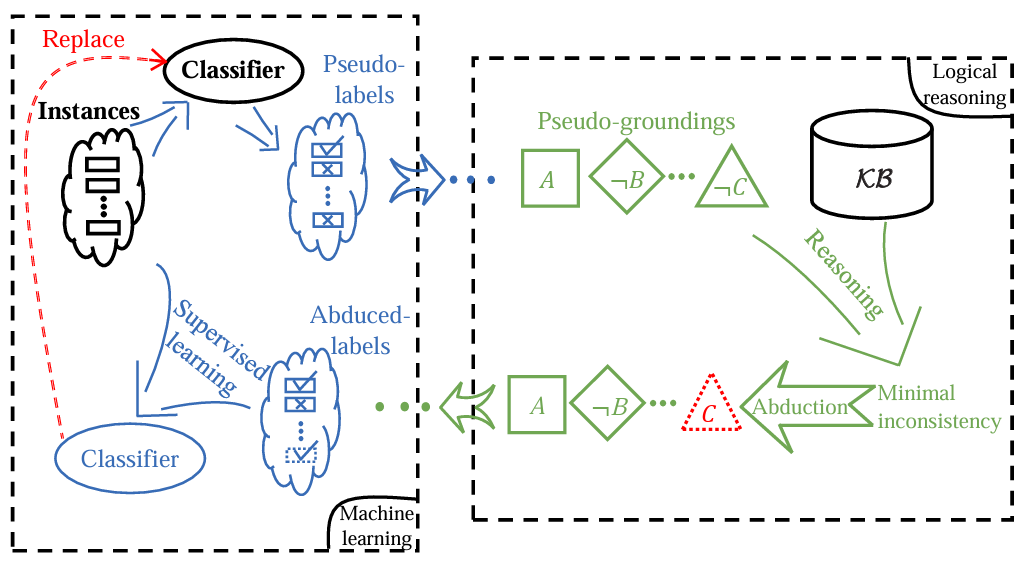
Abductive Learning

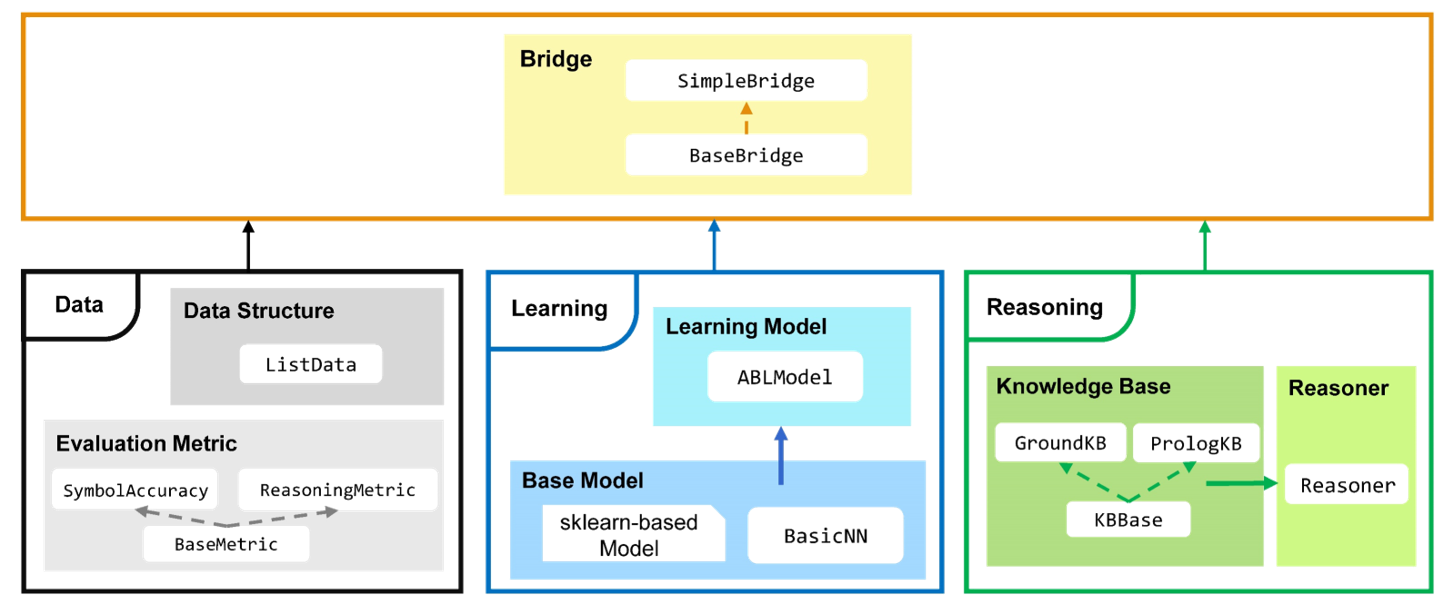
Key Features of ABLkit: - **High Flexibility**: Compatible with various machine learning modules and logical reasoning components. - **Easy-to-Use Interface**: Provide data, model, and knowledge, and get started with just a few lines of code. - **Optimized Performance**: Optimization for high performance and accelerated training speed. ABLkit encapsulates advanced ABL techniques, providing users with an efficient and convenient toolkit to develop dual-driven ABL systems, which leverage the power of both data and knowledge.

ABLkit

## Installation ### Install from PyPI The easiest way to install ABLkit is using ``pip``: ```bash pip install ablkit ``` ### Install from Source Alternatively, to install from source code, sequentially run following commands in your terminal/command line. ```bash git clone https://github.com/AbductiveLearning/ABLkit.git cd ABLkit pip install -v -e . ``` ### (Optional) Install SWI-Prolog If the use of a [Prolog-based knowledge base](https://ablkit.readthedocs.io/en/latest/Intro/Reasoning.html#prolog) is necessary, please also install [SWI-Prolog](https://www.swi-prolog.org/): For Linux users: ```bash sudo apt-get install swi-prolog ``` For Windows and Mac users, please refer to the [SWI-Prolog Install Guide](https://github.com/yuce/pyswip/blob/master/INSTALL.md). ## Quick Start We use the MNIST Addition task as a quick start example. In this task, pairs of MNIST handwritten images and their sums are given, alongwith a domain knowledge base which contains information on how to perform addition operations. Our objective is to input a pair of handwritten images and accurately determine their sum.
Working with Data
ABLkit requires data in the format of `(X, gt_pseudo_label, Y)` where `X` is a list of input examples containing instances, `gt_pseudo_label` is the ground-truth label of each example in `X` and `Y` is the ground-truth reasoning result of each example in `X`. Note that `gt_pseudo_label` is only used to evaluate the machine learning model's performance but not to train it. In the MNIST Addition task, the data loading looks like: ```python # The 'datasets' module below is located in 'examples/mnist_add/' from datasets import get_dataset # train_data and test_data are tuples in the format of (X, gt_pseudo_label, Y) train_data = get_dataset(train=True) test_data = get_dataset(train=False) ```
Building the Learning Part
Learning part is constructed by first defining a base model for machine learning. ABLkit offers considerable flexibility, supporting any base model that conforms to the scikit-learn style (which requires the implementation of `fit` and `predict` methods), or a PyTorch-based neural network (which has defined the architecture and implemented `forward` method). In this example, we build a simple LeNet5 network as the base model. ```python # The 'models' module below is located in 'examples/mnist_add/' from models.nn import LeNet5 cls = LeNet5(num_classes=10) ``` To facilitate uniform processing, ABLkit provides the `BasicNN` class to convert a PyTorch-based neural network into a format compatible with scikit-learn models. To construct a `BasicNN` instance, aside from the network itself, we also need to define a loss function, an optimizer, and the computing device. ```python ​import torch ​from ablkit.learning import BasicNN ​ ​loss_fn = torch.nn.CrossEntropyLoss() ​optimizer = torch.optim.RMSprop(cls.parameters(), lr=0.001, alpha=0.9) ​device = torch.device("cuda" if torch.cuda.is_available() else "cpu") ​base_model = BasicNN(model=cls, loss_fn=loss_fn, optimizer=optimizer, device=device) ``` The base model built above is trained to make predictions on instance-level data (e.g., a single image), while ABL deals with example-level data. To bridge this gap, we wrap the `base_model` into an instance of `ABLModel`. This class serves as a unified wrapper for base models, facilitating the learning part to train, test, and predict on example-level data, (e.g., images that comprise an equation). ```python from ablkit.learning import ABLModel ​ ​model = ABLModel(base_model) ```
Building the Reasoning Part
To build the reasoning part, we first define a knowledge base by creating a subclass of `KBBase`. In the subclass, we initialize the `pseudo_label_list` parameter and override the `logic_forward` method, which specifies how to perform (deductive) reasoning that processes pseudo-labels of an example to the corresponding reasoning result. Specifically, for the MNIST Addition task, this `logic_forward` method is tailored to execute the sum operation. ```python from ablkit.reasoning import KBBase ​ class AddKB(KBBase): def __init__(self, pseudo_label_list=list(range(10))): super().__init__(pseudo_label_list) ​ def logic_forward(self, nums): return sum(nums) ​ kb = AddKB() ``` Next, we create a reasoner by instantiating the class `Reasoner`, passing the knowledge base as a parameter. Due to the indeterminism of abductive reasoning, there could be multiple candidate pseudo-labels compatible to the knowledge base. In such scenarios, the reasoner can minimize inconsistency and return the pseudo-label with the highest consistency. ```python from ablkit.reasoning import Reasoner ​ reasoner = Reasoner(kb) ```
Building Evaluation Metrics
ABLkit provides two basic metrics, namely `SymbolAccuracy` and `ReasoningMetric`, which are used to evaluate the accuracy of the machine learning model's predictions and the accuracy of the `logic_forward` results, respectively. ```python from ablkit.data.evaluation import ReasoningMetric, SymbolAccuracy ​ metric_list = [SymbolAccuracy(), ReasoningMetric(kb=kb)] ```
Bridging Learning and Reasoning
Now, we use `SimpleBridge` to combine learning and reasoning in a unified ABL framework. ```python from ablkit.bridge import SimpleBridge ​ bridge = SimpleBridge(model, reasoner, metric_list) ``` Finally, we proceed with training and testing. ```python ​bridge.train(train_data, loops=1, segment_size=0.01) bridge.test(test_data) ```
To explore detailed tutorials and information, please refer to: [Documentation on Read the Docs](https://ablkit.readthedocs.io/en/latest/index.html). ## Examples We provide several examples in `examples/`. Each example is stored in a separate folder containing a README file. + [MNIST Addition](https://github.com/AbductiveLearning/ABLkit/tree/main/examples/mnist_add) + [Handwritten Formula (HWF)](https://github.com/AbductiveLearning/ABLkit/tree/main/examples/hwf) + [Handwritten Equation Decipherment](https://github.com/AbductiveLearning/ABLkit/tree/main/examples/hed) + [Zoo](https://github.com/AbductiveLearning/ABLkit/tree/main/examples/zoo) ## References For more information about ABL, please refer to: [Zhou, 2019](http://scis.scichina.com/en/2019/076101.pdf) and [Zhou and Huang, 2022](https://www.lamda.nju.edu.cn/publication/chap_ABL.pdf). ``` @article{zhou2019abductive, title = {Abductive learning: towards bridging machine learning and logical reasoning}, author = {Zhou, Zhi-Hua}, journal = {Science China Information Sciences}, volume = {62}, number = {7}, pages = {76101}, year = {2019} } @incollection{zhou2022abductive, title = {Abductive Learning}, author = {Zhou, Zhi-Hua and Huang, Yu-Xuan}, booktitle = {Neuro-Symbolic Artificial Intelligence: The State of the Art}, editor = {Pascal Hitzler and Md. Kamruzzaman Sarker}, publisher = {{IOS} Press}, pages = {353--369}, address = {Amsterdam}, year = {2022} } ``` ## Citation To cite ABLkit, please cite the following paper: [Huang et al., 2024](https://journal.hep.com.cn/fcs/EN/10.1007/s11704-024-40085-7). ``` @article{ABLkit2024, author = {Huang, Yu-Xuan and Hu, Wen-Chao and Gao, En-Hao and Jiang, Yuan}, title = {ABLkit: a Python toolkit for abductive learning}, journal = {Frontiers of Computer Science}, volume = {18}, number = {6}, pages = {186354}, year = {2024} } ```
